Keep the complete detailDryChain · PDF or MarkdownAll sections, plans, figures, expandable notes and sources.
DryChain · The idea and the plan
Grown here.
Made for your market.
We buy crops, make products for other brands and coordinate export. Start with a qualified partner.
Proposed venture · evidence dates shown with sources
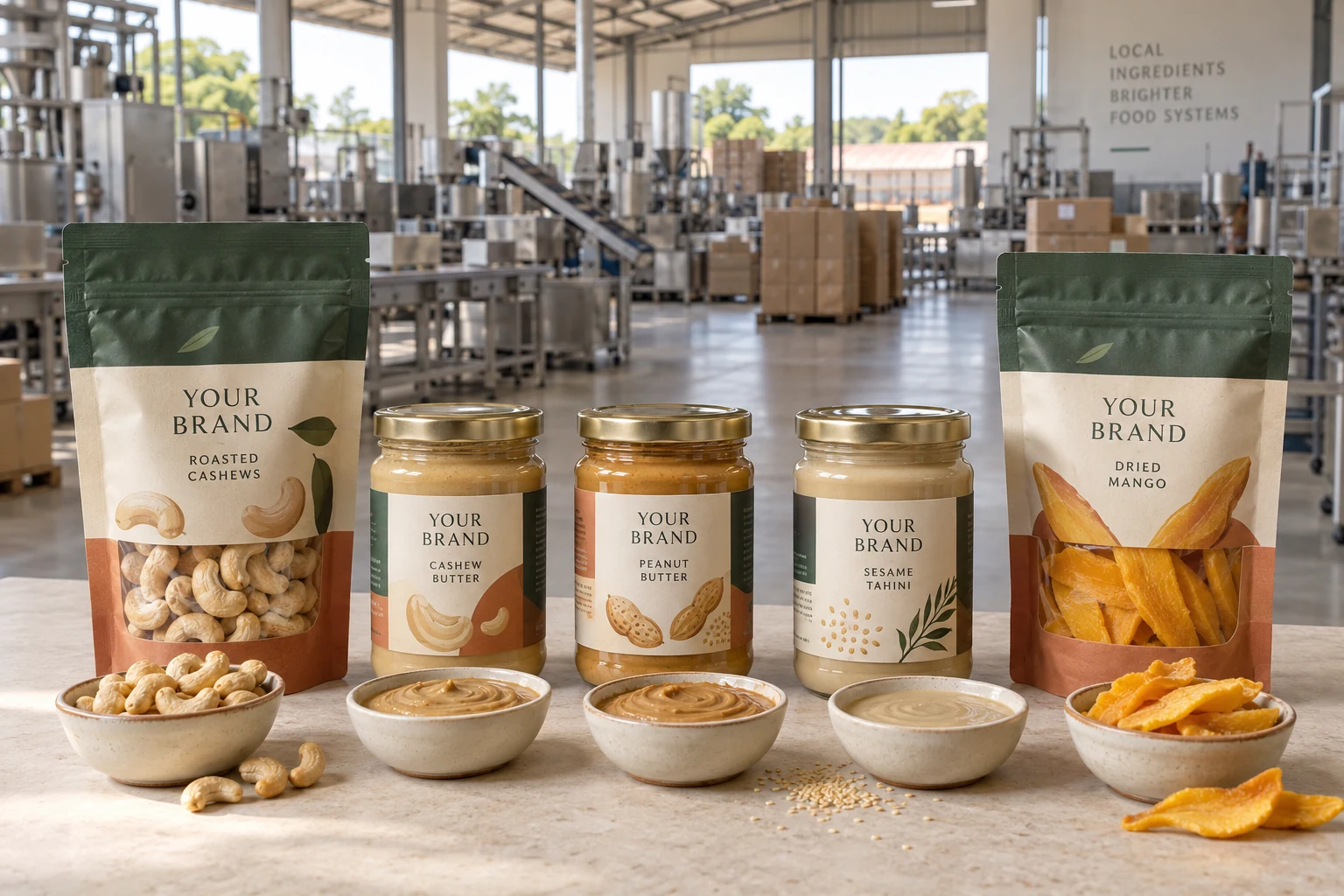
Produce a qualified buyer sample before funding an industrial line.
$3,606Proposed test cash · see the scope01 / Overview · evidence retains its observation date
The first move
Secure a buyer specification. Compare kernels, roasting and butter. Make one qualified partner-produced sample first.
- 01Source
Buy + trace a crop lot
- 02Process
Measure yield + quality
- 03Brand
The buyer’s specification
- 04Dispatch
Release + pallet + export
Three numbers to understand
Oilseeds share of exports
GBoS recorded exports, 2024; broad chapter, not a raw-cashew or sea-freight share.
GBoS · annual merchandise trade 2024European cashew-kernel imports
215,729 tonnes from outside Europe in 2024 (CBI). Kernel demand, not the butter market.
CBI · European cashew marketLocal capacity advertised
Smiling Coast’s own claim; actual utilisation and toll access unverified.
Smiling Coast Agro Processing · facilityMade here. Sold under the buyer’s brand.
The offer.
In three parts.
Buy a traceable crop lot
We own the input and account for rejects.
Make the buyer’s product
Qualified processing, agreed quality and buyer-brand packs.
Coordinate agreed export
Lot release, labels, freight and a responsible importer.
Where we start
Start with a traceable Gambian cashew lot and a qualified importer. Kernel demand does not prove demand for cashew butter.
The question that decidesDoes the accepted delivered price cover crop, yield loss, processing, quality, packing and freight?
Food safety, destination rules and shelf life must be validated. More processing does not automatically mean more margin or longer shelf life.
Service scope + market calculation
Buy and process
We own the approved raw lot and finished goods. Use qualified partner processing first, record all grades/rejects and pay suppliers under agreed terms.
Buyer-brand production
The buyer specifies recipe, grade, pack, artwork and acceptance. Bulk ingredient packs may be a simpler first sale than retail jars; premium products still need an actual buyer.
Quality and agreed export
Coordinate food-safety controls, independent tests, traceability, food-contact packs, destination labels and freight. The named importer and qualified advisers determine actual market-entry responsibilities.
Size from accepted orders, not raw-crop volume.
Input kg × accepted kernel recovery × product yield × collected sale price = sales. Deduct raw crop, every rejected grade, processing, quality, pack, freight, overhead and finance. Sea-freight share must come from customs/port records; it is not estimated from a trade chapter.
02 / Crop suppliers + product buyers · checked 16 Oct 2026
From real suppliers.
To a specific buyer.
DryChain buys the approved crop, arranges qualified production and sells processed goods to an importer or a buyer’s brand.
- 01Buy traceable cropFarmers + origin traders
- 02DryChainQualified processing + export
- 03Sell processed goodsImporter or buyer’s brand
Named research leads, not agreed customers or suppliers. Product fit is our assessment; buying interest, capacity, price and approval are unverified.
Our recommended first conversations · no outreach completed
Get the buyer brief first.
DominikKoRo: test origin-made butter interest. Freeworld: compare the kernel route. No butter order is proven.
View the leadQualify the lot and plant.
Lamin + JoachimFGCFA / Munduk / MM: trace one lot. Smiling Coast: establish actual processing capability and costs.
View the leadChoose the accepted margin.
Dominik + JoachimCompare delivered price, yield, quality costs and cash timing. Henry Lamotte is a separate tahini route.
View the leadA
The purchase + processing side.
Four crop-access routes and one local processor. Verify the actual seller and lot.
Farmer networkGambia · farmer federationFederation of Gambia Cashew Farmers AssociationsRaw cashew nuts
Role to qualifyFarmer access · potential crop sellers through members
Public evidenceIIED’s August 2025 case identifies the federation and its cashew relationship with Munduk.
Why investigate · our assessmentAsk for introductions to traceable member lots; identify the actual seller and signing authority.
- First question
- Which member can offer a traceable lot, with harvest, moisture, quality, weight and price records?
- Who to ask
- Federation leadership → member cooperative
- Still unknown
- Current membership, marketable supply, crop origin, seller authority and commercial terms.
Potential crop supplierSerrekunda · regional sourcingMunduk Trading EnterpriseRaw cashew nuts · groundnuts
Role to qualifyPotential crop supplier · competing trader
Public evidenceIIED describes a Gambian crop trader working with cashew farmer groups and sourcing regionally.
Why investigate · our assessmentCompare an aggregated lot with direct-farmer procurement. Regional stock is not automatically Gambian-grown.
- First question
- Can you segregate a Gambian-grown trial lot and quote quality, traceability, payment and delivery terms?
- Who to ask
- Cashew procurement / commercial management
- Still unknown
- Current offer, lot origin, grade, availability, price and any existing commitments.
Potential crop supplierGambia · West African networkMM Trading & CoRaw cashew nuts · peanuts
Role to qualifyPotential crop supplier · competing origin trader
Public evidenceThe company describes procurement, storage, grading and export of regional raw cashews and peanuts.
Why investigate · our assessmentA second supply quote and a comparison of intake quality and seasonal terms.
- First question
- Which lots are demonstrably Gambian-grown, and what grade, sample, minimum quantity and delivered price can you offer?
- Who to ask
- Origin procurement / sales to processors
- Still unknown
- Actual seller, harvest country, testing, quantity, finance terms and supply continuity.
Farmer networkBrikama · Gambian producer networkNational Association of Women FarmersSesame · groundnuts
Role to qualifyFarmer access · later crop route
Public evidenceTİKA’s November 2024 market report names sesame and groundnuts among members’ produce.
Why investigate · our assessmentQualify sesame for a buyer-led tahini route; do not assume the association owns export-grade stocks.
- First question
- Which members can supply segregated sesame or groundnuts, with current lot volumes and quality records?
- Who to ask
- Association management → producer / marketing lead
- Still unknown
- Current seller, seasonality, contamination controls, traceability and repeatable volume.
ProcessorThe GambiaSmiling Coast Agro ProcessingCashew kernels / partner processing
Role to qualifyProcessor + possible input supplier · competitor
Public evidenceSmiling Coast describes a Gambian cashew facility and direct farmer sourcing.
Why investigate · our assessmentInvestigate kernel purchase or qualified partner processing before investing in a line.
- First question
- Do you sell suitable kernels or accept toll work, and can the actual process meet our buyer’s specification?
- Who to ask
- Factory operations / quality + commercial management
- Still unknown
- Current certificate scope, slot, grades, recovery, minimum batch, cost and any butter capability.
B
Who could buy the product?
Start with the first three. Match product state to buyer; kernels, butter and tahini are different orders.
Potential buyerGermany · European brandKoRoBuyer-brand cashew butter
Role to qualifyPotential finished-product buyer
Public evidenceKoRo sells cashew butter; its listed origin is Côte d’Ivoire and processing is Germany. Indexed product text describes an external supplier change.
Why investigate · our assessmentThe clearest brand-fit conversation for butter; moving production to Gambia is our hypothesis.
- First question
- Would your nut-butter sourcing team qualify fully origin-produced butter, or must processing/filling remain in Europe?
- Who to ask
- Nut-butter sourcing / procurement + quality management
- Still unknown
- New-supplier intake, Gambian-origin acceptance, recipe, certification, pack, volume and price.
KoRo · cashew butter, origin and processing KoRo · sourcing and quality process
Potential buyerUK · European ingredient tradeFreeworld TradingBulk cashew kernels
Role to qualifyPotential kernel importer
Public evidenceExplicitly sources cashew kernels from West Africa, including whole, split and piece formats.
Why investigate · our assessmentA concrete alternative to butter: keep shelling and grading at origin, then sell accepted kernels.
- First question
- Do you qualify new Gambian processors, and what grade, audit, pilot quantity and delivered price are required?
- Who to ask
- Cashew trader / procurement via official company contact
- Still unknown
- Gambia intake, accepted processor, actual specification, minimum order and payment terms.
Potential buyerGermany · ingredient tradeHenry Lamotte FoodTahini in industrial packs
Role to qualifyPotential processed-ingredient buyer
Public evidenceOffers sesame paste in pails/drums and has an explicit new-supplier route with food-safety qualification.
Why investigate · our assessmentA separate sesame-paste route, not an assumed cashew-butter order or a change to the published trial budget.
- First question
- Would you consider qualified Gambian tahini, and what process, GFSI-recognised certification and pack approval come before samples?
- Who to ask
- Purchasing / sesame category via supplier enquiry route
- Still unknown
- New-origin acceptance, qualified plant, product brief, minimum volume and target price.
Henry Lamotte Food · sesame paste Henry Lamotte Food · become a supplier
Potential buyerNetherlandsNutlandCashews · peanuts · sesame · dried mango
Role to qualifyPotential bulk-ingredient buyer
Public evidencePublishes global sourcing and a range covering these crops.
Why investigate · our assessmentQualify one grade and product state; no finished-butter buying evidence found.
- First question
- Which category accepts new origin suppliers, and what specification, minimum lot and approval route apply?
- Who to ask
- Nuts / seeds / dried-fruit procurement
- Still unknown
- Actual buying brief, accepted origin, audit requirements, volume and price.
Potential buyerUK · European officesVoicevaleCashew kernels / nut ingredients
Role to qualifyPotential importer · integrated competitor
Public evidenceDescribes importing/distributing ingredients and interests in origin processing.
Why investigate · our assessmentA kernel procurement route to qualify; existing partner factories may already cover it.
- First question
- Does your cashew team qualify independent Gambian processors, and against which origin and quality requirements?
- Who to ask
- Nut product manager + technical department
- Still unknown
- Open sourcing need, relevant grade, approval, volume and commercial terms.
Potential buyerNetherlands · international groupBATA FOOD EuropeCashews · tahini / nut pastes
Role to qualifyPotential ingredient buyer · processor / competitor
Public evidencePublishes ingredient sourcing, processing and a range that includes nuts and pastes.
Why investigate · our assessmentCheck whether it buys finished paste from third parties rather than only processing through its own network.
- First question
- Do you buy independently produced origin tahini or nut paste, and what release and pilot-lot criteria apply?
- Who to ask
- Ingredient procurement / trader for nuts and pastes
- Still unknown
- External procurement model, new-origin intake, plant qualification, pack and volume.
Potential buyerNetherlands · organic ingredientsTradin OrganicOrganic kernels + cashew butter
Role to qualifyPotential organic ingredient buyer · integrated processor
Public evidenceIts B2B range includes several cashew grades and butter.
Why investigate · our assessmentA butter-category lead; the catalogue does not prove it purchases external origin-made butter.
- First question
- Do you onboard independent West African butter processors, and what organic and factory approvals are necessary?
- Who to ask
- Organic nuts / nut-butter sourcing + quality
- Still unknown
- External purchasing, organic eligibility, audit, volume, specification and price.
Potential buyerNetherlandsRhumveld Winter & KonijnDried mango slices / diced fruit
Role to qualifyPotential bulk dried-fruit buyer
Public evidencePublishes origin sourcing and dried-mango formats, organic and conventional.
Why investigate · our assessmentA separate seasonal fruit route after qualifying drying, yield, residue and shelf-life requirements.
- First question
- Would you qualify a Gambian mango processor, and what cut, moisture, test panel and minimum lot are needed?
- Who to ask
- Dried-fruit sourcing / trader + quality
- Still unknown
- Gambia intake, current buying need, accepted product, audit and delivered price.
Rhumveld · sourcing and services Rhumveld · dried mango formats
A kernel buyer is not automatically a white-label buyer.
Freeworld’s West African sourcing supports a kernel conversation. KoRo’s butter listing supports a brand-fit conversation, but its listed processing is in Germany. No source confirms demand for Gambian-made butter. Henry Lamotte’s sesame-paste route has its own food-safety qualification. The current $3,606 cashew trial stays a conditional planning allowance; changing product means repricing the trial.
Earlier reserve leads remain Heinrich Brüning and Zieler & Co; both may also compete in processing or private label. Institut Pasteur de Dakar remains a laboratory enquiry route, subject to method scope and availability. Brüning evidence · Zieler evidence · Laboratory evidence
Crop → process → buyer-defined product
Several product routes.
One qualified order first.
Cashew
Bulk kernels / roasted snacks / buyer-specified butter
Grade kernels → roast or mill
Quality + commercial check
Priority to compare. Butter is a proposed test, not the proven best market.
Groundnuts
Peanut spread / roasted nuts
Sort → validated roast → mill
Quality + commercial check
Established crop; aflatoxin, allergens and accepted flavour are decisive.
Mango
Unsweetened strips / fruit bites
Select → cut → controlled dry
Quality + commercial check
Seasonal complementary line. Measure fresh-to-dry yield, residues and packaging.
Sesame
Graded seeds / tahini
Clean → suitable treatment → mill
Quality + commercial check
Additional buyer-led option; validate local traceable supply and process safety.
Hibiscus + baobab
Tea ingredients / specified fruit pulp powder
Clean → qualify → pack / mill
Quality + commercial check
From the supplied concept; supplier volume, contaminant controls and exact legal product status need qualification.
Later by-products
Shell energy / other secondary products
Separate engineered recovery
Quality + commercial check
Do not include revenue yet. Shell handling, emissions, process hazards and product approval need their own work.
Products are proposals, not market-approved recipes, confirmed orders or a claim of longer life than every raw crop. Different lines need their own food-safety, energy and commercial validation.
Competition · what customers already use
Established African processors
Smiling Coast and gebana show that origin processing already exists. A factory alone is not differentiation; compare product quality, delivered cost, reliable volume and buyer access.
Smiling Coast Agro Processing · facilitygebana Trade · Burkina FasoGlobal nut suppliers
Europe has established kernel and groundnut supply chains. Compare accepted saleable grades and full freight/quality costs; European shelf prices are not our factory receipts.
CBI · European cashew marketCBI · groundnut market entryEuropean importers and finishers
Some buyers want to roast, blend or pack near sale. Test whether origin finishing adds value for that buyer before adding machinery or retail packaging.
CBI · cashew market entryHeinrich Brüning · products and white labelZieler · bulk peanut spreadWhat we keep from the supplied concept
The DryChain PDF contributes buying at origin, toll processing, multiple products, seasonal cash and industrial expansion. Its Casamance factory budget, Senegal subsidy, 2031 revenue and multi-country rollout describe another scope. They are not transferred to the Gambian white-label sample or presented as secured finance.
Source: DryChain · Konzept 2.0, 6 October 2026, supplied by the owner. The German concept and its English summary describe historical internal planning. Later user decisions take precedence. No excluded business idea is restored.
Quality + growth
Prove the essentials.
Then repeat.
Technical, quality and expansion requirements
01The white-label order, end to end
Approve one product brief before buying crop: buyer, recipe/grade, quantity, pack size, target price, acceptable defects, test panel, shelf-life requirement, artwork and payment security. Track raw-lot IDs through processing, rejects, packing, release and export documents. The buyer’s brand is not a substitute for a quality system.
02Quality is part of production
Qualified food specialists define hazard controls, validated processing, allergen segregation and lot release. The lab must be accredited for the relevant methods/scope. Verify contaminants against the applicable product category and current rules. Shelf life requires process, barrier-pack and storage evidence; roasting or grinding is not an automatic extension of raw-nut life.
03Europe: assign responsibilities before dispatch
The responsible importer checks current product/origin controls, tariff classification, preferential-origin evidence and any required entry documents. Agree destination-language labels, food-contact compliance, lot/date information, complaints/recall and who pays for rejection. A retailer’s BRCGS/IFS/FSSC requirement is a commercial qualification, not a blanket statutory EU certificate.
04Build an industrial system without buying it on day one
Partner-made proof comes first; a 250 kg raw-cashew sample does not prove a factory. After repeat paid orders, quote complete intake, specialist line, utilities/heat, quality, packing, storage, dispatch, staffing, commissioning and seasonal inventory. New crops need dedicated controls; electricity alone does not make shelling, safe roasting or filling simple.
05Keep the cash cycle visible
The current 10-tonne planning campaign produces only $684 before tax/founder costs under its assumptions. A small price/yield/freight change can erase that. Fund crop purchase through buyer collection, maintain release/claim reserves and do not count stock finance, speculative subsidies or unsold by-products as margin.
Four conditions for moving forward · our decision criteria
Buyer
One priced specification and an identified importer / acceptance route.
Production
A qualified partner and a completely costed, funded trial.
Release
Safe accepted product, traceability and agreed lawful dispatch.
Repeat
Collected commercial payment and viable seasonal working capital.
03 / Our proposed start plan · not started
Start with a clear plan.
Build it together.
The first proofOne buyer specification. One qualified product sample.
Validation cash · proposed$3,606Budget + scope Three buyer briefs → a qualified partner → a traceable buyer-brand sample.
01–03 · Qualify + run the test04 · Decide the next investment separately
- 01
Before reserving a crop lotCoordinates · Dominik Choose the product before buying crop.
Compare kernels, roasted nuts and butter against a real buyer’s specification and delivered price.
- Lamin
- Local access + operations
- Check traceable supply, seasonality and processor candidates.
- Request samples and indicative crop terms; do not buy the campaign.
- Joachim
- Technical design + delivery
- Assess process, hazards and recovery with a food technologist.
- Screen whether the proposed processor can meet the buyer brief.
- Dominik
- Business + software
- Seek buyer briefs: KoRo for butter; Freeworld for kernels; Lamotte for a separate sesame route.
- Define product, pack, target price, acceptance, importer and payment terms.
Bring to the next decision- One written buyer/product brief
- Feasible partner-production route
- A chosen product to qualify
Move forward whenA credible buyer need, defined acceptance requirements and a potentially qualified processor exist.
Scope + specialist checks
The named firms are discovery routes, not confirmed buyers. Compare accepted delivered margin, not retail shelf prices. Butter is a proposed option, not a predetermined winning product.
The handoverDominik passes the buyer specification to Joachim and Lamin.
- 02
Before commissioning productionCoordinates · Joachim Approve the partner and sample plan.
Use the 250 kg raw-cashew/butter test budget only if it matches the buyer brief; otherwise reprice the trial.
- Lamin
- Local access + operations
- Quote the traceable lot, processor, packs and local transport.
- Confirm storage, traceability and an available production slot.
- Joachim
- Technical design + delivery
- Engage a food technologist and a suitably accredited lab.
- Audit actual partner controls; agree tests, process and qualified release criteria.
- Dominik
- Business + software
- Agree the buyer pack/artwork and lawful sample-import route.
- Approve all quoted trial fees and cash; reprice any missing tests.
Bring to the next decision- Qualified partner + test panel
- A fully quoted sample plan
- Named release authority + importer route
Move forward whenPartner capability, specialist/importer requirements and complete test funding are agreed.
Scope + specialist checks
Smiling Coast and Institut Pasteur de Dakar are enquiry routes, not booked partners. Independently verify certificate/method scope and availability. The $3,606 trial cash is an allowance, not a recurring product-cost estimate.
The handoverJoachim hands the approved process and release brief to Lamin.
- 03
One approved sample campaignCoordinates · Lamin Follow one lot to an accepted sample.
Buy only the approved lot, record all yields and hold the product until qualified release.
- Lamin
- Local access + operations
- Coordinate partner processing, packing and secure storage.
- Record lot IDs, weights, rejects, time and actual costs.
- Joachim
- Technical design + delivery
- Have specialists review process records and lab results.
- Reconcile actual yield/cost; the named qualified authority decides release.
- Dominik
- Business + software
- Prepare buyer records and agreed artwork with advisers.
- Coordinate lawful released-sample dispatch and document buyer feedback.
Bring to the next decision- Traceable, qualified released sample
- Actual yield + full cost record
- Buyer assessment against the brief
Move forward whenSafety, specification and import/dispatch conditions are met. Rejected or unqualified goods do not ship.
Scope + specialist checks
The model assumes 250 kg raw input yields 52.25 kg butter. That recovery is not validated. Product shelf life and labels require specialist evidence; buyer-brand artwork is not approval.
The handoverLamin and Joachim pass the sample evidence and buyer response to Dominik.
- 04
Next investment · Separate commercial-batch decisionCoordinates · Dominik Fund one order before building scale.
Turn sample acceptance into a priced, funded buyer-brand order with clear export and payment responsibilities.
- Lamin
- Local access + operations
- Secure traceable crop and partner capacity for the ordered lot.
- Coordinate approved local intake, production and dispatch.
- Joachim
- Technical design + delivery
- Validate repeat-batch controls, costs and shelf-life work with specialists.
- Compare partner capacity with adding local processing steps.
- Dominik
- Business + software
- Agree price, acceptance, payment security and importer/freight responsibilities.
- Fund the seasonal cash gap, coordinate export and collect payment.
Bring to the next decision- Funded commercial order
- Released shipment + collected payment
- A costed repeat-production case
Move forward whenAccepted repeat orders, safe production and seasonal cash justify scale; a sample approval alone is insufficient.
Scope + specialist checks
The later 10-tonne campaign is a different scope from the sample. Own industrial lines require a separately qualified investment case; no subsidy, uncontracted order or unsold by-product revenue is assumed.
ThenUse paid repeat orders to decide which process step stays at origin next.
Preparation + shared working file
Start with these three actions.
Request traceable crop and qualified processor options.
Prepare the process, testing and partner-qualification brief.
Qualify KoRo for butter, Freeworld for kernels and Lamotte for a separate tahini route.
One shared working fileBuyer specification · lot/yield record · release file · landed-cost sheet
Qualified help we must bring in
Qualified food technologist / HACCP team, accredited testing laboratory, packaging/label adviser, export forwarder and the legally responsible destination importer. The founders coordinate; they do not replace these qualifications.
At every decisionContinue. Adjust. Or stop.
Review the evidence together. Record the decision, the person responsible, the spending limit and the next review date. Dates follow access, quotes and approvals.
04 / The first test · checked 15 October 2026
The first test.
Clearly costed.
250 kg raw cashew · one traceable trial
Make one buyer-defined product first.
Produce a qualified buyer sample before funding an industrial line.
Full test scope
Use 250 kg of traceable raw in-shell cashew with a qualified local processor. An illustrative 22% accepted kernel recovery × 95% butter yield gives 52.25 kg of cashew butter; actual output may differ. Eleven food-grade 5 kg pails provide up to 55 kg capacity. This is a qualification/sample lot, not a commercial export campaign.
Cash to have available · USD$3,606
Proposed budget, not a supplier quotation.
Full item-by-item calculation · USD
Traceable in-shell cashew: 250 × $1.10 = $275; Partner trial processing minimum: $400; Scoped laboratory tests + report: $800; Food technologist: 2 × $250 = $500; Food-grade 5 kg pails: 11 × $10 = $110; Label, specification + sample-export review: $300; Buyer-sample courier allowance: $250; Local transport: 4 × $30 = $120; Cleaning + trial consumables: $100; Provisional taxes / permissions: $150. Subtotal = $3,005; plus 20% contingency $601 = $3,606 of test spending including the reserve. Total cash required: $3,606. No customer receipts or assumed resale/refunds are deducted.
Quantities, reference prices and quote gaps
| Item + scope | Quantity × unit | Cash |
|---|---|---|
| Traceable in-shell cashewUnconfirmed local crop price; not a kernel price · test cost | 250 × $1.10 | $275 |
| Partner trial processing minimumPreparation, roasting and milling scope to quote; small-batch minimum, not industrial unit cost · test cost | 1 × $400 | $400 |
| Scoped laboratory tests + reportForeign public benchmark $627.60 before courier/card/extra tests; final qualified panel may cost more · test cost | 1 × $800 | $800 |
| Food technologistLocal allowance · written quote required · test cost | 2 × $250 | $500 |
| Food-grade 5 kg pailsLocal allowance · written quote required · test cost | 11 × $10 | $110 |
| Label, specification + sample-export reviewLocal allowance · written quote required · test cost | 1 × $300 | $300 |
| Buyer-sample courier allowanceNamed route, documents and sample admission must be quoted; no commercial sea freight included · test cost | 1 × $250 | $250 |
| Local transportLocal allowance · written quote required · test cost | 4 × $30 | $120 |
| Cleaning + trial consumablesLocal allowance · written quote required · test cost | 1 × $100 | $100 |
| Provisional taxes / permissionsAllowance, not a statutory rate · test cost | 1 × $150 | $150 |
| 20% contingency on $3,005 | 20% | $601 |
| Total cash required | Before receipts | $3,606 |
A documented process/yield, a qualified test-and-release assessment, a buyer-reviewed bulk sample and a realistic purchase-to-payment cost sheet. A sample cannot establish long-term shelf life, repeat orders or industrial-line economics.
An owned factory, full commercial sea export, comprehensive certification/shelf-life programme, destination import taxes/duties and retail launch. The food specialist/lab/importer must agree the panel, methods, sampling and sample-import route before production or dispatch. There is no blanket sample exemption or guaranteed EU acceptance.
Planning allowances, not local quotes. Includes a 20% reserve; excludes founder pay and travel. No sales receipts are deducted.
Budget basis, exclusions + next-stage funding
All local prices, specialist day rates and the 20% reserve are proposed allowances until written offers replace them. Relevant overseas references appear in Sources; they are not Gambian landed quotes. Provisional tax/permission amounts are not legal rates. Founders’ time is unpaid in this test; founders’ pay and travel are excluded. Add them before approval if needed. There is no supplier commitment or booking yet. No paid goods are released without the applicable qualified checks.
The later deployment case below has a different scale and scope. Do not add both budgets mechanically: reconcile test spending and reusable assets already included in launch lines before funding the next stage.
Read the test correctly · calculated from the stated assumptions
A qualification sample is not factory economics.
250 kg raw cashew → 52.25 kg butter under the model’s yield assumptions. $3,606 trial cash ÷ 52.25 kg = $69.01/kg; this is not a recurring production cost.
Calculation + what the test can prove
The assumed 250 kg lot gives 52.25 kg butter. The $3,606 trial cash is about $69.01/kg of assumed sample output, including specialist work, testing and reserve. It is not a recurring product cost or selling price. The later 10,000 kg campaign uses different batch assumptions and returns only $684 before tax/founder costs. Confirm processor minimum batch, yield, accredited tests and buyer acceptance before producing anything.
What the later investment model includes
Illustrative 10-tonne raw in-shell cashew campaign → prepared kernels → cashew butter in buyer-branded bulk pails. Local partner processing first. Each process, lot, pack and destination must be qualified; partner availability is not confirmed.
05 / The later investment case
The numbers.
With the assumptions visible.
Our first recommendation
The later 10-tonne campaign leaves only $684 before tax and founder costs in the planning case. Validate price, yield and freight before scaling.
How this business earns
Paid volume×Collected price−Full operating costs=Cash to fund the business
Planning cases below are team assumptions, not verified Gambian offers or customer prices. Reference facts and their limits appear in the source cards.
Cash after operation + reserve
per batch · before tax
- Accepted kernel recovery
- 20 % of in-shell weight
- Saleable butter yield
- 93 % of accepted kernel weight
- Net buyer selling price
- 9.5 USD / kg butter
- Farmer / supplier crop purchase
- 1.2 USD / kg in-shell
Cash after operation + reserve
per batch · before tax
- All inputs
- As listed below
Cash after operation + reserve
per batch · before tax
- Accepted kernel recovery
- 24 % of in-shell weight
- Saleable butter yield
- 97 % of accepted kernel weight
- Net buyer selling price
- 11 USD / kg butter
- Farmer / supplier crop purchase
- 1 USD / kg in-shell
One campaign, not a monthly result. No annual batch count or full-plant return is assumed. Figures are USD, before income tax and founders’ pay/travel; debt defaults to zero. Negative scenarios are intentionally retained.
Separate scale · later deployment / launch
Deployment is only part
of the cash needed.
Launch spend $17–33k + campaign / liquidity $24–42k = $41–75k. This funds an illustrative partner-produced proof, not an industrial factory.
Deployment / launch$25,500
Liquidity$32,000
See every budget line
| Scope | Allowance range | Selected case |
|---|---|---|
| Processor qualification + process trialsTechnical partner and pilot time allowance | $5,000–$9,000 | $7,000 |
| Food-safety advice, tests + sample validationProduct / buyer-specific scope to quote | $4,000–$8,000 | $6,000 |
| Buyer-pack development + trial toolingMock-up artwork is not a compliant label | $2,000–$4,000 | $3,000 |
| Traceability + simple operating toolsNo large platform build | $1,000–$2,000 | $1,500 |
| Commercial / export setup + legal scopeBuyer, manufacturer and importer responsibilities | $2,000–$4,000 | $3,000 |
| Launch contingencyExplicit team allowance | $3,000–$6,000 | $5,000 |
| Deployment / launch total | $17,000–$33,000 | $25,500 |
| Crop + partner processing campaign | $14,000–$24,000 | $18,000 |
| Packing, testing + freight timing | $6,000–$10,000 | $8,000 |
| Operating and delay buffer | $4,000–$8,000 | $6,000 |
| Combined funding | $41,000–$75,000 | $57,500 |
Outside the scope: Owned shelling/roasting/grinding plant, factory building, industrial utility connection, land, destination import VAT/duties, brand-owner retail marketing and founders’ travel/pay. The own-plant investment case must be quoted separately.
Freight and provisional non-recoverable tax/clearance costs are inside the stated allowances where listed. Actual duty, VAT treatment, permits and charges still need a broker/accountant assessment. No tax exemption is assumed. Recoverable VAT, if any, can create an additional timing gap.
Full calculation + editable assumptions
The selected case · change any input
See what has to work.
10,000 kg in-shell × 22% accepted kernels × 95% saleable butter × $10.50/kg.
Sales income / batch$21,945
Operating costs + reserve + financing$21,261
Cash before tax / batch$684
Positive operating cash does not prove an investable return.
Raw crop purchase$11,000
Partner kernel preparation$3,000
Roast + mill$1,430
Buyer-brand packing$1,881
Tests + export documents$900
Agreed freight$1,800
Allocated overhead$1,000
Risk / equipment reserve$250
Financing cost$0
Includes operation, reserve and the financing input. Does not recover launch spending.
All batch costs less assumed buyer advance; conservative timing, before launch spending.
Edit the assumptions
Selected funding inputs: $57,500. Output: 2,090 kg saleable butter per batch.
How to interpret and stress-test the result
What the result means.
This model does not compare a kilogram of raw nuts with a kilogram of finished product. It tracks recovery at both steps. The planning margin is thin: buyer price, raw quality and accepted yield dominate. No shell/by-product income is assumed. Five similar batches are not assumed to occur or sell in a year.
Stress the case
First test: a lower yield and lower buyer price together. Then add a delayed payment, extra $2,000 freight/retesting, and the cost of rejecting a whole lot. Qualify the product, not just the machinery.
Watch the cash timing
Conservative batch cash gap = all campaign costs less buyer advance, assuming costs fall due before the balance is collected. No supplier credit assumed. The launch liquidity budget also covers delay buffer; do not add the same batch costs a second time. A full dated stock/payment plan is still required.
06 / Evidence register · dated references
Facts with context.
Assumptions you can replace.
Sources retain their observation dates. Test allowances: 15 Oct 2026. Named counterparties and cold-chain evidence: 16 Oct. No customer, supplier, financing or partnership agreement is implied.
Market + operating sources · 16 references
Market / operating evidenceGBoS · annual merchandise trade 2024
Reports oilseeds at 72.6% and edible fruits/nuts at 8.6% of recorded exports. Broad chapters do not isolate Gambian-grown raw cashew, the raw share or seaborne tonnage.
Read the original sourceMarket / operating evidenceGBoS · IMTS 2025 releases
The checked catalogue lists Q1 2025. The 2024 annual report is the full-year comparator used here, not a claim that newer customs data do not exist.
Read the original sourceMarket / operating evidenceCBI · European cashew market
Reports 215,729 tonnes of extra-European kernel imports in 2024. The study includes EU, UK and EFTA; this is kernel trade, not the size of the cashew-butter market.
Read the original sourceMarket / operating evidenceCBI · cashew market entry
Specialised importers are a more accessible starting channel than direct retail tenders. Private-label access depends on quality, audits, cost and buyer requirements.
Read the original sourceMarket / operating evidenceCBI · groundnut market entry
Highlights food-safety/buyer requirements and established suppliers including Argentina, China, the US and Brazil. A Gambian product must compete on a delivered, accepted specification.
Read the original sourceMarket / operating evidenceSmiling Coast Agro Processing · facility
The Gambian operator advertises up to 5,000 tonnes/year processing capacity and HACCP certification, with BRCGS work in progress. These are self-reported, not audited by us or available toll-processing capacity.
Read the original sourceMarket / operating evidenceHeinrich Brüning · products and white label
Hamburg nut/dried-fruit importer offering white-label products. A possible sourcing conversation and established competitor, not a confirmed buyer of Gambian production.
Read the original sourceMarket / operating evidenceZieler · bulk peanut spread
Lists peanut spread in 5 and 9 kg packs and describes its own nut-puree production. Bulk pack evidence, not an offer to buy our butter or evidence of a cashew-butter price.
Read the original sourceMarket / operating evidencegebana Trade · Burkina Faso
Reports a new 2025 processing factory and cashew/dried-mango activity. An established origin-processing benchmark and competitor, not our partner or a budget for Gambia.
Read the original sourceMarket / operating evidenceSIAL Paris · official dates and exhibitor access
An immediate buyer-discovery route if meetings can be arranged. Attendance, travel, tickets and orders are not included or assumed in the trial budget.
Read the original sourceMarket / operating evidenceEuropean Commission · imported food controls
Check controls for the exact product, origin, processing and destination with the responsible importer. A buyer brand or laboratory result is not blanket EU market authorisation.
Read the original sourceMarket / operating evidenceEUR-Lex · food contaminants regulation
The applicable category and current amendments govern contaminant limits. The qualified lab/importer must identify the relevant limits and sampling for the actual product.
Read the original sourceMarket / operating evidenceYour Europe · food labelling
Destination language, ingredients/allergens, required operator information and other applicable particulars must be checked for the actual pack.
Read the original sourceMarket / operating evidenceEuropean Commission · Access2Markets
Classify the final product, confirm origin and document the chosen trade route before calculating duty. A raw-crop tariff cannot simply be transferred to nut butter.
Read the original sourceMarket / operating evidenceInstitut Pasteur de Dakar · food/water expertise
Describes food/water analysis and HACCP/ISO 17025 support. Obtain a current quotation and independently verify accreditation for each required method; no full cashew test panel or available slot is confirmed.
Read the original sourceMarket / operating evidenceFSQA · startup food-business guideline
Provides a food-business startup/registration route. Confirm applicable site, handling, water, processing and inspection requirements with FSQA before operations.
Read the original sourceCrop suppliers + product buyers · 15 source references
Checked 16 October 2026. Dates distinguish current retrieval from publication. Company claims are not site audits or purchase commitments. No company has been contacted. Roles are suggested enquiry routes, not introductions.
Counterparty / goods evidenceIIED · Gambian cashew partnership case
Gambia case, pp. 14–17, names FGCFA and Munduk. Historical research, not a current offer, assured supply volume or exclusive contract. PDF: https://www.iied.org/sites/default/files/pdfs/2025-08/22662iied.pdf
Read the original sourceCounterparty / goods evidenceMM Trading & Co · raw crop procurement
Company describes regional raw cashew and peanut sourcing with Gambian presence. Regional procurement is not proof of Gambian-grown origin.
Read the original sourceCounterparty / goods evidenceTİKA · NAWFA farmer market in Brikama
Project report names sesame, groundnuts and processed products from women farmers. Does not establish a current export-grade lot or an association supply contract.
Read the original sourceCounterparty / goods evidenceSmiling Coast · cashew processing
Operator describes Gambian processing and farmer sourcing. Available toll capacity, butter processing, current certificates and scope are unverified.
Read the original sourceCounterparty / goods evidenceKoRo · cashew butter, origin and processing
Product table lists Côte d’Ivoire origin and German processing. Own-site indexed narrative describes an external supplier change. No demand for Gambian-made butter is established.
Read the original sourceCounterparty / goods evidenceKoRo · sourcing and quality process
Describes supplier samples, recipe iteration, specifications and quality review. Historical process description, not a supplier invitation or current purchasing brief.
Read the original sourceCounterparty / goods evidenceFreeworld Trading · cashew procurement
Explicit West African kernel sourcing and whole/split/piece formats. Not evidence of Gambian buying, butter procurement or acceptance of a new supplier.
Read the original sourceCounterparty / goods evidenceHenry Lamotte Food · sesame paste
Tahini offered in industrial packs including pails/drums. Product range alone does not prove appetite for Gambian production.
Read the original sourceCounterparty / goods evidenceHenry Lamotte Food · become a supplier
Open supplier-discovery route; generally requires a GFSI-recognised food-safety certification. This is a buyer qualification requirement, not a blanket statutory EU certificate.
Read the original sourceCounterparty / goods evidenceNutland · sourcing and product range
Worldwide sourcing and cashew, peanut, sesame and dried-mango range. Finished butter procurement is not evidenced.
Read the original sourceCounterparty / goods evidenceVoicevale · importer and sourcing model
Importer/distributor with origin-factory interests. Independent Gambian supplier onboarding or butter procurement is not established.
Read the original sourceCounterparty / goods evidenceBATA FOOD · ingredients and sourcing
Ingredient sourcing, processing and product portfolio. Its own facility certifications do not automatically specify requirements for every external supplier.
Read the original sourceCounterparty / goods evidenceTradin Organic · cashew products
Offers organic cashew grades and butter. A product offer does not establish external butter procurement or acceptance of a new origin.
Read the original sourceCounterparty / goods evidenceRhumveld · sourcing and services
Origin sourcing and ingredient distribution/processing model. No Gambian order or new-supplier demand confirmed.
Read the original sourceCounterparty / goods evidenceRhumveld · dried mango formats
Dried mango slices/diced formats, organic and conventional. No price, minimum order or Gambian intake commitment inferred.
Read the original sourceThe supplied concept contributes planning ideas; it is not independent market verification. Public programmes and investments are not funding commitments to us. No grant, subsidy, customer prepayment, credit facility or certification is included unless the financial scope explicitly says so.
Cost + finance sources · 11 references
Historical market price referenceCBI · European cashew market entry
Reports Vietnamese W320 kernel offers around $7.20–7.50/kg in Q4 2025. This is a different origin, product and delivery basis from raw Gambian crop or buyer-branded butter. It is a negotiation reference, not evidence for our $10.50/kg butter assumption.
Read the original sourceLocal capability referenceSmiling Coast · Gambian processor
Local processing capability is already present in Gambia. Assess qualified partnership and differentiation. No relationship, available capacity or toll-processing offer is confirmed.
Read the original sourceTechnical scopeComCashew · processing guides
Use specialist process, equipment, hygiene and traceability guidance. The model’s 22% kernel recovery and 95% product yield still require actual lot and recipe trials.
Read the original sourceQuote requiredGELGOOG · nut-butter equipment
Equipment routes exist but the official range requires quotations. Marketplace headline prices are not adopted as installed food-safe line budgets. An own line includes utilities, hygiene, commissioning and working capital.
Read the original sourceRequired validationEuropean Commission · entry conditions
Check exact product/origin requirements, controls and responsible importer. No generic EU approval or automatic preferential tariff is assumed.
Read the original sourceRequired validationYour Europe · food labelling
Prepare the destination-language label and required food/operator information with the responsible buyer/importer and qualified advisers. Buyer-brand artwork alone is not approval.
Read the original sourceFirst-test analysis benchmarkUniversity of Arizona · food-testing prices
Illustrative two-sample panel: raw aflatoxin/moisture $90; finished aflatoxin, Salmonella, yeast/mould, aerobic count, water activity/moisture $230. $320 × 1.18 administration + minimum $250 report = $627.60. Card payment adds 15%; confirmation, extra tests and courier are extra. A qualified adviser must select the actual accredited scope; this is not EU approval.
Read the original sourceDestination qualificationEuropean Commission · imported food controls
Product, origin and destination determine import controls, documentation and sampling. The destination importer and food adviser must check the current rules for the exact cashew product and samples. Buyer-brand packaging is not market authorisation.
Read the original sourceDated FX referenceCBG · first-test currency conversion
GMD per currency unit: USD 73.22; GBP 96.94; AED 19.94; EUR 83.67. Rounded USD cross-rates are used only for the new first-test references. Valuation is not a bank dealing rate. Earlier investment references retain their original dated conversions.
Read the original sourceFX referenceCBG · daily valuation
The CBG homepage displayed GMD 73.22/USD, 83.67/EUR and 4.40/ZAR. Indicative cross-rates: USD 1.143/EUR and USD 0.06009/ZAR. Valuation rates are not dealing rates. Earlier equipment-reference conversions retain their original observation date; no planning allowance is a binding offer.
Read the original sourceLocal confirmationGambia Revenue Authority · tax and customs
Obtain a product-code-specific landed-cost and tax assessment. No import-duty exemption, recoverable VAT or investment incentive is assumed. Tax and clearance allowances below are provisional amounts, not statutory rates.
Read the original sourceBefore an investment decision
Replace the allowances with complete local/landed quotes, the sales inputs with customer or buyer evidence, and the operating inputs with a measured pilot. Add taxes, founder costs, month-by-month seasonality, exchange exposure and financing terms to the full cash-flow forecast. These transparent pre-feasibility cases are the starting point for that work.